

Hey there! As a supplier of Gpf Carbon Black, I've been getting a lot of questions lately about how it affects the color of rubber products. So, I thought I'd take a deep - dive into this topic and share some insights with you all.
First off, let's understand what Gpf Carbon Black is. Gpf stands for General Purpose Furnace Carbon Black. It's a type of carbon black that's widely used in the rubber industry. Carbon black is produced by the incomplete combustion or thermal decomposition of hydrocarbons. Gpf Carbon Black has unique physical and chemical properties that make it a popular choice for various rubber applications.
Now, onto the main question: how does Gpf Carbon Black affect the color of rubber products? Well, the most obvious effect is that it gives rubber a black color. When you add Gpf Carbon Black to rubber compounds, it disperses throughout the rubber matrix. The carbon black particles absorb light across a wide range of wavelengths. This absorption of light is what makes the rubber appear black.
The intensity of the black color depends on several factors. One of the key factors is the loading level of Gpf Carbon Black in the rubber. The more carbon black you add, the darker the rubber will become. For example, if you're making a rubber product where a very deep, intense black color is required, you'll need to use a higher loading of Gpf Carbon Black. On the other hand, if you only need a slightly tinted or a lighter black color, a lower loading can be used.
Another factor is the particle size of the Gpf Carbon Black. Smaller particle - sized carbon black tends to give a more intense black color. This is because smaller particles have a larger surface area per unit mass. With a larger surface area, they can absorb more light, resulting in a darker appearance. In contrast, larger particle - sized carbon black may give a less intense black color as it has a relatively smaller surface area for light absorption.

The dispersion of Gpf Carbon Black in the rubber also plays a crucial role. If the carbon black is not well - dispersed, you may end up with uneven color distribution in the rubber product. You might see patches of lighter and darker areas. To ensure a uniform black color, proper mixing and dispersion techniques are essential. This could involve using specialized mixing equipment and additives to help break down the carbon black agglomerates and distribute them evenly throughout the rubber.
Let's talk about the applications of Gpf Carbon Black in different rubber products and how it impacts their color. In tire manufacturing, Carbon Black for Tyres is a big deal. Tires are typically black because of the addition of carbon black, including Gpf Carbon Black. The black color not only gives tires a sleek and professional look but also provides some functional benefits. Carbon black helps to protect the rubber in tires from the harmful effects of UV radiation. The black color absorbs the UV rays, preventing them from breaking down the rubber molecules and extending the lifespan of the tires.
In industrial rubber products like conveyor belts and gaskets, Gpf Carbon Black is also commonly used. These products often require a consistent black color for aesthetic and functional reasons. The black color can make the products look more durable and professional. And just like in tires, the carbon black also enhances the mechanical properties of the rubber, such as abrasion resistance and tear strength.
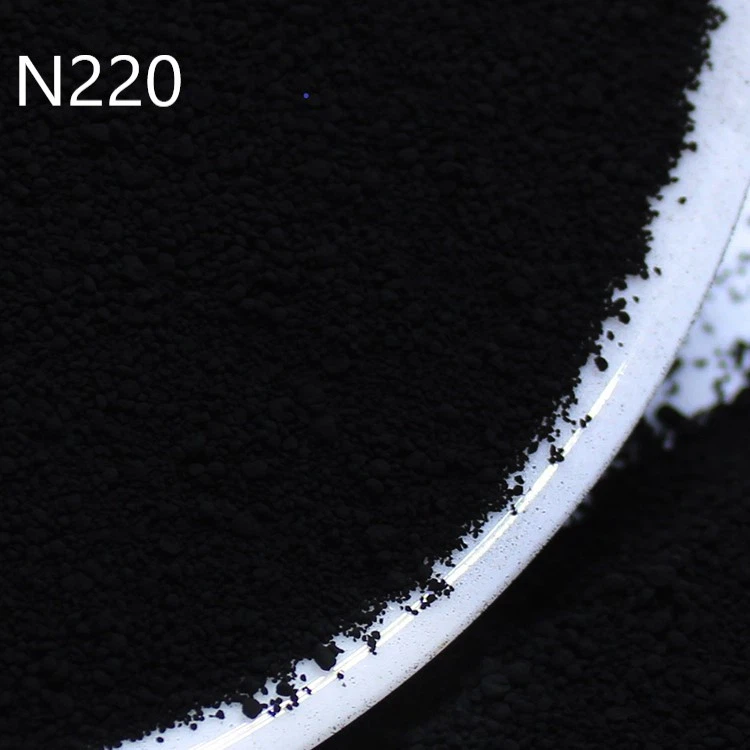
Now, let's compare Gpf Carbon Black with other types of carbon black in terms of color. For instance, N220 Carbon Black is another popular type of carbon black used in the rubber industry. N220 has a smaller particle size compared to Gpf Carbon Black. As a result, it can give a more intense and jet - black color to rubber products. However, Gpf Carbon Black offers a good balance between color and other properties. It may not provide the same level of intense blackness as N220, but it's more cost - effective and can still meet the color requirements for many applications.
Carbon Black N375 is yet another option. It has different characteristics from Gpf Carbon Black. Carbon Black N375 is often used when a specific balance of color, reinforcement, and processability is needed. In some cases, a blend of Gpf Carbon Black and Carbon Black N375 may be used to achieve the desired color and performance in rubber products.
In addition to the basic black color, Gpf Carbon Black can also have an impact on the appearance of rubber products in other ways. For example, it can affect the glossiness of the rubber surface. A well - dispersed and properly formulated rubber compound with Gpf Carbon Black can have a smooth, semi - gloss finish. This can enhance the overall look of the product, making it more appealing to consumers.
If you're in the business of making rubber products and are looking for a reliable source of Gpf Carbon Black, I'm here to help. Whether you need a specific color intensity for your rubber products or are looking to improve other properties like durability and UV resistance, our Gpf Carbon Black can be a great solution. We've got a wide range of options to meet your different requirements.
If you're interested in learning more or want to discuss your specific needs, don't hesitate to reach out. We can have a detailed chat about how our Gpf Carbon Black can work for you and help you get the best results for your rubber products.
References
- "Carbon Black in Rubber Applications" - Rubber Technology Handbook
- "The Science of Color in Rubber Compounds" - Journal of Rubber Science and Technology