

Oxidation resistance is a crucial property for many materials, especially in industrial applications where materials are often exposed to oxygen and high - temperature environments. As a supplier of Cas No Carbon Black, I am well - versed in the oxidation resistance properties of this remarkable substance. In this blog, I will delve into the details of these properties, explaining what they are, how they work, and why they matter in various industries.
Understanding Oxidation and Its Impact
Oxidation is a chemical reaction that occurs when a substance reacts with oxygen. In the case of carbon black, oxidation can lead to a series of changes in its physical and chemical properties. For instance, oxidation can cause the surface of carbon black to become more polar, which may affect its dispersion in polymers or other matrices. It can also lead to a decrease in the particle size due to the removal of carbon atoms from the surface, and in extreme cases, it can even cause the carbon black to lose its reinforcing properties in rubber or other composite materials.
The oxidation of carbon black typically occurs at elevated temperatures, especially in the presence of catalysts or under conditions where the oxygen concentration is high. The rate of oxidation depends on several factors, including the structure of the carbon black, its surface area, and the nature of any impurities present.
Oxidation Resistance Mechanisms of Cas No Carbon Black
One of the key factors contributing to the oxidation resistance of Cas No Carbon Black is its unique structure. Carbon black consists of small, spherical particles that are often aggregated and agglomerated into larger structures. The graphitic nature of the carbon atoms in these particles provides a certain degree of stability against oxidation. The delocalized electrons in the graphite layers form a strong bond, making it more difficult for oxygen molecules to react with the carbon atoms.
Another important aspect is the surface chemistry of carbon black. The surface of Cas No Carbon Black can be modified during the manufacturing process to enhance its oxidation resistance. For example, by introducing certain functional groups or coatings on the surface, the reactivity of the carbon black towards oxygen can be reduced. These surface modifications can act as a barrier, preventing oxygen from reaching the underlying carbon atoms and initiating the oxidation reaction.
The particle size and structure of carbon black also play a role in its oxidation resistance. Smaller particle sizes generally have a higher surface area, which can increase the reactivity with oxygen. However, if the particles are well - dispersed and have a proper structure, they can still exhibit good oxidation resistance. Aggregated and agglomerated structures can provide some protection to the inner particles, reducing their exposure to oxygen.
Applications Benefiting from Oxidation Resistance
Rubber Industry
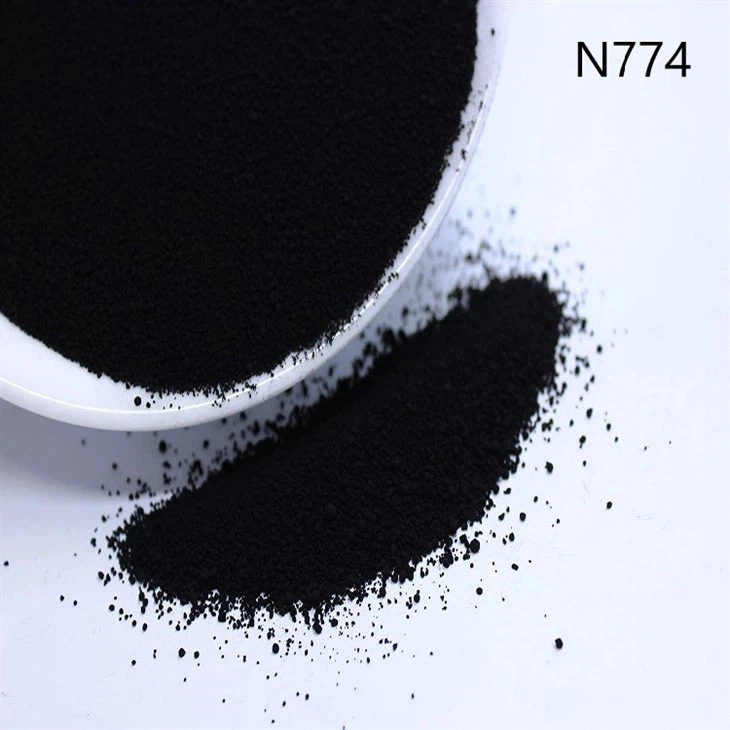
In the rubber industry, oxidation resistance is of utmost importance. Carbon Black for Rubber is widely used as a reinforcing filler to improve the mechanical properties of rubber products. Oxidation can degrade the rubber matrix and the carbon black filler over time, leading to a loss of strength, elasticity, and durability. Cas No Carbon Black with good oxidation resistance helps to maintain the performance of rubber products, such as tires, seals, and hoses, even under harsh environmental conditions. For example, N774 Carbon Black is known for its excellent oxidation resistance and is often used in applications where long - term durability is required.
Plastics Industry
In plastics, carbon black is used as a colorant, UV stabilizer, and conductive filler. Oxidation can cause discoloration, embrittlement, and a decrease in the electrical conductivity of plastic products. Cas No Carbon Black with high oxidation resistance can prevent these issues, ensuring that plastic products maintain their appearance and performance over their lifespan. For example, in automotive plastic parts, which are exposed to high temperatures and sunlight, carbon black with good oxidation resistance helps to prevent degradation and maintain the integrity of the parts.

Coating Industry
In coatings, carbon black is used to provide color, opacity, and anti - static properties. Oxidation of carbon black in coatings can lead to a change in color, loss of gloss, and a decrease in the protective properties of the coating. Cas No Carbon Black with excellent oxidation resistance ensures that coatings remain stable and perform well over time, even in outdoor or high - temperature applications.
Testing and Evaluation of Oxidation Resistance
There are several methods available to test the oxidation resistance of Cas No Carbon Black. One common method is thermogravimetric analysis (TGA). In TGA, a sample of carbon black is heated in an oxygen - containing atmosphere, and the weight loss of the sample is measured as a function of temperature. The temperature at which significant weight loss occurs due to oxidation can be used as an indicator of the oxidation resistance of the carbon black.
Another method is differential scanning calorimetry (DSC). DSC measures the heat flow associated with the oxidation reaction. By analyzing the heat flow curves, information about the onset temperature, reaction rate, and enthalpy of the oxidation reaction can be obtained. These data can be used to compare the oxidation resistance of different types of carbon black.
Comparing Different Grades of Carbon Black for Oxidation Resistance
Different grades of carbon black, such as Carbon Black N375 and N774, have different oxidation resistance properties. The choice of carbon black grade depends on the specific application requirements. For applications where high - temperature stability and long - term oxidation resistance are critical, grades with a more graphitic structure and appropriate surface modifications are preferred.
Carbon Black N375, for example, is a high - structure carbon black that offers good reinforcement and some degree of oxidation resistance. It is commonly used in rubber products where a balance between mechanical properties and oxidation resistance is required. On the other hand, N774 Carbon Black is known for its excellent oxidation resistance and is often used in applications where the rubber or other material is exposed to harsh environmental conditions.
Factors Affecting the Oxidation Resistance of Cas No Carbon Black in Real - World Applications
In real - world applications, several factors can affect the oxidation resistance of Cas No Carbon Black. Temperature is one of the most significant factors. Higher temperatures accelerate the oxidation reaction, reducing the effectiveness of the carbon black's oxidation resistance. Humidity can also play a role, as water vapor can enhance the reactivity of oxygen and promote the oxidation process.
The presence of other chemicals or additives in the system can either enhance or reduce the oxidation resistance of carbon black. For example, some antioxidants can be added to the rubber or plastic matrix to further improve the oxidation resistance of the carbon black. However, certain impurities or incompatible additives can have a negative impact on the oxidation resistance.
Conclusion and Call to Action
In conclusion, the oxidation resistance properties of Cas No Carbon Black are essential for its performance in a wide range of industrial applications. Its unique structure, surface chemistry, and particle characteristics contribute to its ability to resist oxidation, ensuring the long - term stability and performance of products in which it is used.
If you are in need of high - quality Cas No Carbon Black with excellent oxidation resistance for your specific application, I invite you to contact me for more information and to discuss your procurement needs. Whether you are in the rubber, plastics, or coating industry, we can provide you with the right grade of carbon black to meet your requirements.
References
- Donnet, J. B., & Bansal, R. C. (1993). Carbon Black Science and Technology. Marcel Dekker.
- Kraus, G. (1984). Reinforcement of Elastomers. Hanser Publishers.
- Wypych, G. (2012). Handbook of Fillers, Second Edition. ChemTec Publishing.